 Add to Chrome
 Add to Firefox
 Add to Edge
CoMem: Context Management with A Decoupled Long-Context Model
May 29, 2026
Context management enables agentic models to solve long-horizon tasks through iterative summarization of previous interaction histories. However, this process typically incurs substantial decoding overhead for the extra summarization tokens, which significantly affect the end-to-end response latency at deployment. In this paper, we introduce CoMem, a novel framework that decouples memory management from the primary agent workflow, enabling these processes to execute in parallel. We propose a $k$-step-off asynchronous pipeline that overlaps the memory model's summarization with the agent's inference, effectively masking the latency of context processing. To ensure robustness under this asynchronous setting, we introduce a reward-driven training strategy that aligns the memory model to capture sufficient statistics for the agent's decision-making. Theoretical analysis confirms that CoMem offers a superior efficiency-effectiveness trade-off compared to coupled architectures. Our extensive experimental results on SWE-Bench-Verified show that CoMem provides 1.4x latency improvements upon vanilla long-context solutions while preserving most of the performance. Furthermore, we demonstrate that these latency gains scale favorably with increased system throughput, offering a modular path forward for the independent optimization of agent reasoning and memory compression.

EHRBench: An Automated and Reliable EHR-based Benchmark for Clinical Decision Making with LLMs
May 28, 2026Clinical decision-making (CDM) is central to real-world clinical workflows, where clinicians infer diagnoses, select treatments, or anticipate future health outcomes under incomplete evidence. LLMs are increasingly used to support these decisions due to strong language capabilities, broad biomedical knowledge, and efficiency, yet the reliability of LLMs on real-world clinical decision tasks remains insufficiently understood. To evaluate CDM models, especially LLM-based models, an ideal and practical medical decision benchmark should be constructed via an automated yet reliable pipeline to ensure both scale and quality. Moreover, the grounding of a CDM benchmark in real patient EHRs can better support evaluation on practical CDM tasks that require substantive biomedical knowledge and clinical inference. To fill the gaps, we introduce EHRBench, an automated and reliable EHR-grounded benchmark for evaluating LLM-based clinical decision-making at scale. To ensure scalability and reliability, EHRBench is constructed through an EHR-LLM-KB(knowledge-base) interaction pipeline. For efficiency, we use a specialized LLM to automatically convert encounter-level EHR trajectories into structured templates and deterministically instantiate the templates into QA items. In parallel, we apply systematic KB-based verification and enrichment to filter hallucinated or ambiguous relations and to improve reliability. Using this pipeline, we construct nearly 1M (960,067) QA items spanning three core inference-required clinical decision tasks: diagnosis, treatment, and prognosis. We benchmark more than 30 representative LLMs on EHRBench and provide detailed analyses of performance and robustness. The results show consistent capability trends across settings, further validating the reliability of EHRBench and highlighting actionable gaps toward clinically reliable LLM systems.
T$^2$PO: Uncertainty-Guided Exploration Control for Stable Multi-Turn Agentic Reinforcement Learning
May 04, 2026Recent progress in multi-turn reinforcement learning (RL) has significantly improved reasoning LLMs' performances on complex interactive tasks. Despite advances in stabilization techniques such as fine-grained credit assignment and trajectory filtering, instability remains pervasive and often leads to training collapse. We argue that this instability stems from inefficient exploration in multi-turn settings, where policies continue to generate low-information actions that neither reduce uncertainty nor advance task progress. To address this issue, we propose Token- and Turn-level Policy Optimization (T$^2$PO), an uncertainty-aware framework that explicitly controls exploration at fine-grained levels. At the token level, T$^2$PO monitors uncertainty dynamics and triggers a thinking intervention once the marginal uncertainty change falls below a threshold. At the turn level, T$^2$PO identifies interactions with negligible exploration progress and dynamically resamples such turns to avoid wasted rollouts. We evaluate T$^2$PO in diverse environments, including WebShop, ALFWorld, and Search QA, demonstrating substantial gains in training stability and performance improvements with better exploration efficiency. Code is available at: https://github.com/WillDreamer/T2PO.
Stepwise Penalization for Length-Efficient Chain-of-Thought Reasoning
Feb 27, 2026Large reasoning models improve with more test-time computation, but often overthink, producing unnecessarily long chains-of-thought that raise cost without improving accuracy. Prior reinforcement learning approaches typically rely on a single outcome reward with trajectory-level length penalties, which cannot distinguish essential from redundant reasoning steps and therefore yield blunt compression. Although recent work incorporates step-level signals, such as offline pruning, supervised data construction, or verifier-based intermediate rewards, reasoning length is rarely treated as an explicit step-level optimization objective during RL. We propose Step-wise Adaptive Penalization (SWAP), a fine-grained framework that allocates length reduction across steps based on intrinsic contribution. We estimate step importance from the model's on-policy log-probability improvement toward the correct answer, then treat excess length as a penalty mass redistributed to penalize low-importance steps more heavily while preserving high-importance reasoning. We optimize with a unified outcome-process advantage within group-relative policy optimization. Extensive experiments demonstrate that SWAP reduces reasoning length by 64.3% on average while improving accuracy by 5.7% relative to the base model.
HeaPA: Difficulty-Aware Heap Sampling and On-Policy Query Augmentation for LLM Reinforcement Learning
Jan 30, 2026RLVR is now a standard way to train LLMs on reasoning tasks with verifiable outcomes, but when rollout generation dominates the cost, efficiency depends heavily on which prompts you sample and when. In practice, prompt pools are often static or only loosely tied to the model's learning progress, so uniform sampling can't keep up with the shifting capability frontier and ends up wasting rollouts on prompts that are already solved or still out of reach. Existing approaches improve efficiency through filtering, curricula, adaptive rollout allocation, or teacher guidance, but they typically assume a fixed pool-which makes it hard to support stable on-policy pool growth-or they add extra teacher cost and latency. We introduce HeaPA (Heap Sampling and On-Policy Query Augmentation), which maintains a bounded, evolving pool, tracks the frontier using heap-based boundary sampling, expands the pool via on-policy augmentation with lightweight asynchronous validation, and stabilizes correlated queries through topology-aware re-estimation of pool statistics and controlled reinsertion. Across two training corpora, two training recipes, and seven benchmarks, HeaPA consistently improves accuracy and reaches target performance with fewer computations while keeping wall-clock time comparable. Our analyses suggest these gains come from frontier-focused sampling and on-policy pool growth, with the benefits becoming larger as model scale increases. Our code is available at https://github.com/horizon-rl/HeaPA.
WebCoach: Self-Evolving Web Agents with Cross-Session Memory Guidance
Nov 17, 2025Multimodal LLM-powered agents have recently demonstrated impressive capabilities in web navigation, enabling agents to complete complex browsing tasks across diverse domains. However, current agents struggle with repetitive errors and lack the ability to learn from past experiences across sessions, limiting their long-term robustness and sample efficiency. We introduce WebCoach, a model-agnostic self-evolving framework that equips web browsing agents with persistent cross-session memory, enabling improved long-term planning, reflection, and continual learning without retraining. WebCoach consists of three key components: (1) a WebCondenser, which standardizes raw navigation logs into concise summaries; (2) an External Memory Store, which organizes complete trajectories as episodic experiences; and (3) a Coach, which retrieves relevant experiences based on similarity and recency, and decides whether to inject task-specific advice into the agent via runtime hooks. This design empowers web agents to access long-term memory beyond their native context window, improving robustness in complex browsing tasks. Moreover, WebCoach achieves self-evolution by continuously curating episodic memory from new navigation trajectories, enabling agents to improve over time without retraining. Evaluations on the WebVoyager benchmark demonstrate that WebCoach consistently improves the performance of browser-use agents across three different LLM backbones. With a 38B model, it increases task success rates from 47% to 61% while reducing or maintaining the average number of steps. Notably, smaller base models with WebCoach achieve performance comparable to the same web agent using GPT-4o.
KERAP: A Knowledge-Enhanced Reasoning Approach for Accurate Zero-shot Diagnosis Prediction Using Multi-agent LLMs
Jul 03, 2025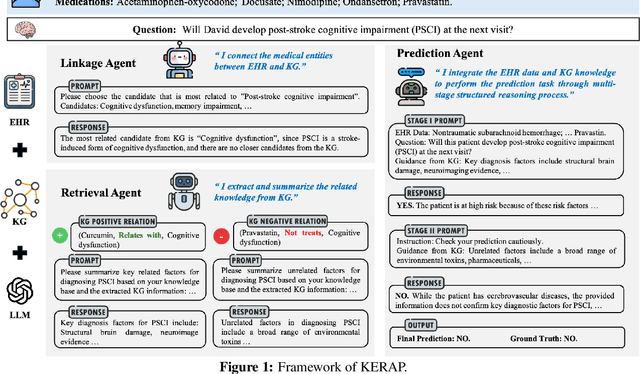
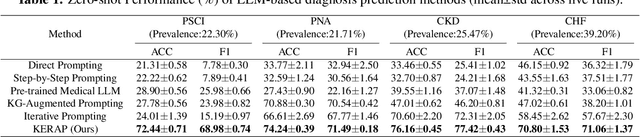

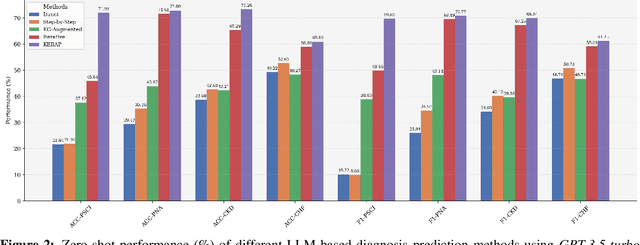
Medical diagnosis prediction plays a critical role in disease detection and personalized healthcare. While machine learning (ML) models have been widely adopted for this task, their reliance on supervised training limits their ability to generalize to unseen cases, particularly given the high cost of acquiring large, labeled datasets. Large language models (LLMs) have shown promise in leveraging language abilities and biomedical knowledge for diagnosis prediction. However, they often suffer from hallucinations, lack structured medical reasoning, and produce useless outputs. To address these challenges, we propose KERAP, a knowledge graph (KG)-enhanced reasoning approach that improves LLM-based diagnosis prediction through a multi-agent architecture. Our framework consists of a linkage agent for attribute mapping, a retrieval agent for structured knowledge extraction, and a prediction agent that iteratively refines diagnosis predictions. Experimental results demonstrate that KERAP enhances diagnostic reliability efficiently, offering a scalable and interpretable solution for zero-shot medical diagnosis prediction.
MedHELM: Holistic Evaluation of Large Language Models for Medical Tasks
May 26, 2025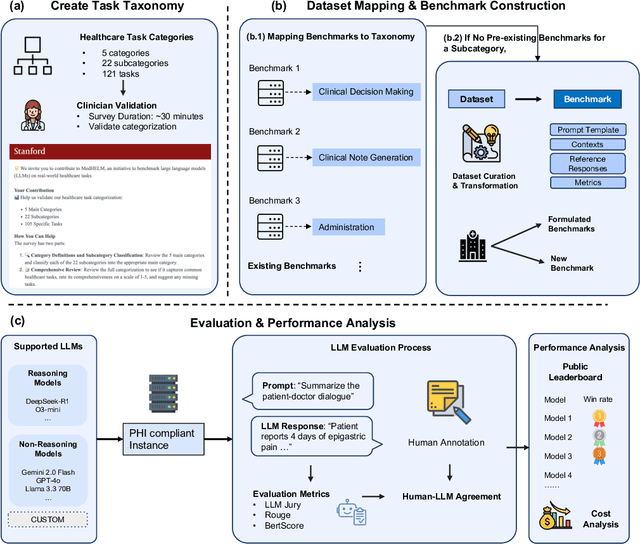
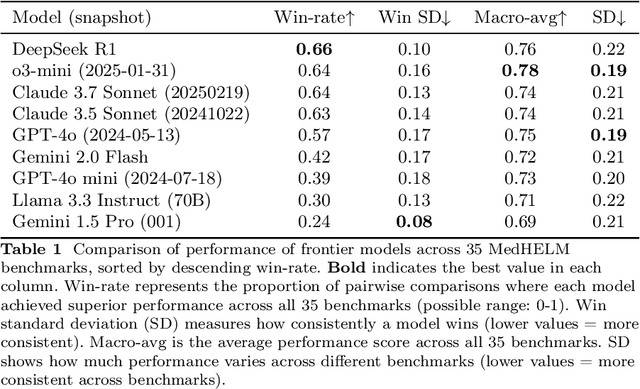
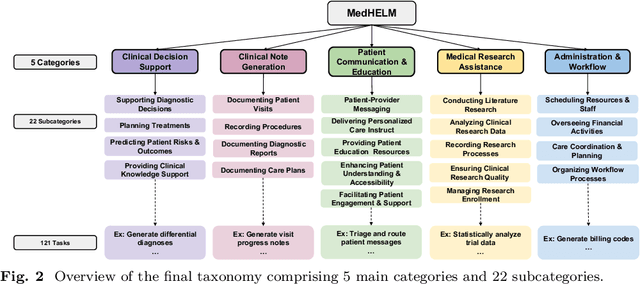

While large language models (LLMs) achieve near-perfect scores on medical licensing exams, these evaluations inadequately reflect the complexity and diversity of real-world clinical practice. We introduce MedHELM, an extensible evaluation framework for assessing LLM performance for medical tasks with three key contributions. First, a clinician-validated taxonomy spanning 5 categories, 22 subcategories, and 121 tasks developed with 29 clinicians. Second, a comprehensive benchmark suite comprising 35 benchmarks (17 existing, 18 newly formulated) providing complete coverage of all categories and subcategories in the taxonomy. Third, a systematic comparison of LLMs with improved evaluation methods (using an LLM-jury) and a cost-performance analysis. Evaluation of 9 frontier LLMs, using the 35 benchmarks, revealed significant performance variation. Advanced reasoning models (DeepSeek R1: 66% win-rate; o3-mini: 64% win-rate) demonstrated superior performance, though Claude 3.5 Sonnet achieved comparable results at 40% lower estimated computational cost. On a normalized accuracy scale (0-1), most models performed strongly in Clinical Note Generation (0.73-0.85) and Patient Communication & Education (0.78-0.83), moderately in Medical Research Assistance (0.65-0.75), and generally lower in Clinical Decision Support (0.56-0.72) and Administration & Workflow (0.53-0.63). Our LLM-jury evaluation method achieved good agreement with clinician ratings (ICC = 0.47), surpassing both average clinician-clinician agreement (ICC = 0.43) and automated baselines including ROUGE-L (0.36) and BERTScore-F1 (0.44). Claude 3.5 Sonnet achieved comparable performance to top models at lower estimated cost. These findings highlight the importance of real-world, task-specific evaluation for medical use of LLMs and provides an open source framework to enable this.
Data Foundations for Large Scale Multimodal Clinical Foundation Models
Mar 09, 2025

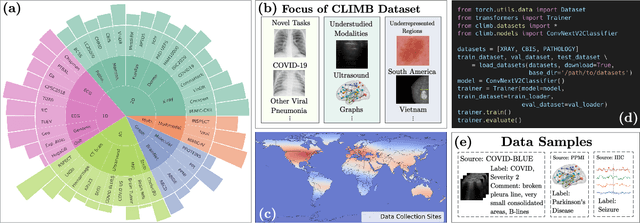
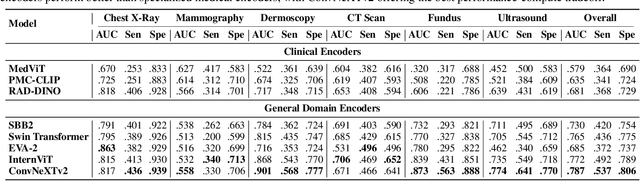
Recent advances in clinical AI have enabled remarkable progress across many clinical domains. However, existing benchmarks and models are primarily limited to a small set of modalities and tasks, which hinders the development of large-scale multimodal methods that can make holistic assessments of patient health and well-being. To bridge this gap, we introduce Clinical Large-Scale Integrative Multimodal Benchmark (CLIMB), a comprehensive clinical benchmark unifying diverse clinical data across imaging, language, temporal, and graph modalities. CLIMB comprises 4.51 million patient samples totaling 19.01 terabytes distributed across 2D imaging, 3D video, time series, graphs, and multimodal data. Through extensive empirical evaluation, we demonstrate that multitask pretraining significantly improves performance on understudied domains, achieving up to 29% improvement in ultrasound and 23% in ECG analysis over single-task learning. Pretraining on CLIMB also effectively improves models' generalization capability to new tasks, and strong unimodal encoder performance translates well to multimodal performance when paired with task-appropriate fusion strategies. Our findings provide a foundation for new architecture designs and pretraining strategies to advance clinical AI research. Code is released at https://github.com/DDVD233/climb.
TIMER: Temporal Instruction Modeling and Evaluation for Longitudinal Clinical Records
Mar 06, 2025Large language models (LLMs) have emerged as promising tools for assisting in medical tasks, yet processing Electronic Health Records (EHRs) presents unique challenges due to their longitudinal nature. While LLMs' capabilities to perform medical tasks continue to improve, their ability to reason over temporal dependencies across multiple patient visits and time frames remains unexplored. We introduce TIMER (Temporal Instruction Modeling and Evaluation for Longitudinal Clinical Records), a framework that incorporate instruction-response pairs grounding to different parts of a patient's record as a critical dimension in both instruction evaluation and tuning for longitudinal clinical records. We develop TIMER-Bench, the first time-aware benchmark that evaluates temporal reasoning capabilities over longitudinal EHRs, as well as TIMER-Instruct, an instruction-tuning methodology for LLMs to learn reasoning over time. We demonstrate that models fine-tuned with TIMER-Instruct improve performance by 7.3% on human-generated benchmarks and 9.2% on TIMER-Bench, indicating that temporal instruction-tuning improves model performance for reasoning over EHR.